
Water Metering Project
Water Meter Installation Open House
The City of Revelstoke hosted two Open House events for residents to meet Neptune Technology Group’s Project Managers and learn about the water meter installations. To watch the recorded Open House, please click here, and, "click here" to watch the youtube videos.
Read the Media Release HERE
Background
The City of Revelstoke is introducing a Water Meter Program, supported by a provincial grant of $4,460,000.00 from the Government of British Columbia. This project will install water meters on residential, commercial and industrial properties connected to the City's water system. This project is about conserving water and using it more responsibly. In March 2025, Council approved applying for provincial funding and committed municipal funding to support the sustainable initiative.
Water meters help reduce both overall water use and peak demand, which is when water use is highest, typically during hot summer days. Lower peak demand helps protect the water supply and supports better planning for the future. With meters installed across the community, the City can better understand how water is used and identify water loss, such as leaks. This information helps improve system efficiency and reliability.
Water meters have been shown to encourage:
- Water Conservation,
- Reduce Water Demand,
- Make Utility Billing More Equitable,
- Help Detect and Resolve Leaks within the System,
- Enhance Water Planning, and
- Support Climate Change Resiliency.
Click HERE to read more about the City's Water Use and the Water Metering Plan.
How Do Water Meters Work?
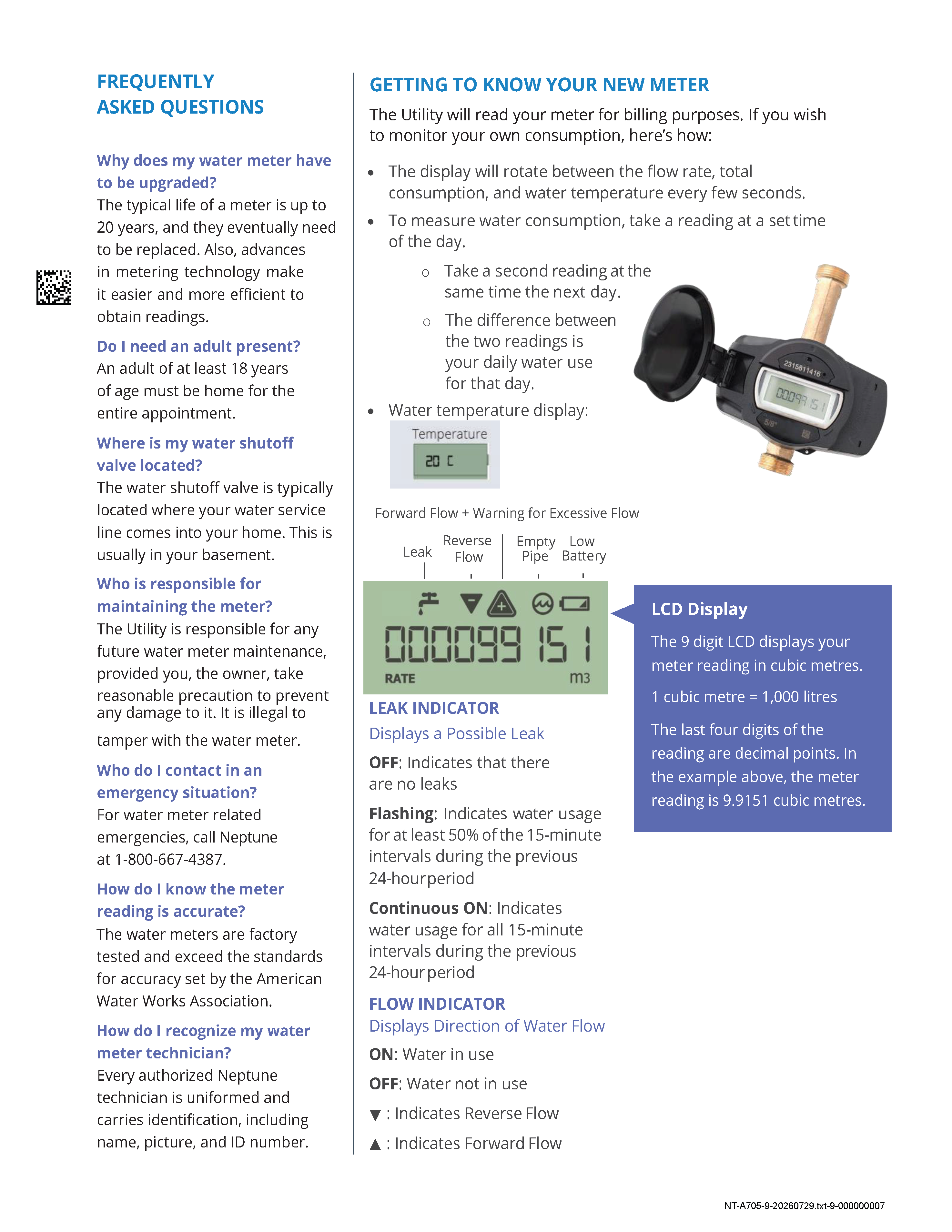
A water meter is a simple device that measures how much water flows into your home or business. The easiest way to think of it is like a car odometer: instead of tracking how many kilometers you’ve driven, it keeps track of how much water you’ve used. As water passes through, the meter records the total volume amount and displays it in cubic meters. Water meters allow residents' utility charges will be calculated according to their measured water consumption.
Water meters and volume-based billing can lead to water savings in the distribution system through:
- End-user demand reductions,
- Leak reduction, and
- Reduction in water distribution system loss due to improved ability to identify and locate leaks.
What are the Benefits of Water Meters?
Benefits associated with water metering materialize from reduced water demand and improved water use billing and accounting.
The Advantages of Installing Water Meters include:
- Greater Fairness for Residents
Water metering allows billing based on actual usage, so residents who conserve pay less and those who use more pay their fair share. This encourages efficiency and gives households control over their water costs. - Risk Mitigation Against Drought or Supply Interruption
Water metering helps the City reduce demand, leaving more water available during droughts or emergencies. This improves reliability of the Greeley Creek supply, supports firefighting and other critical needs, and provides a buffer if key infrastructure fails. Metering also benefits the environment by keeping more water in streams and supporting healthy aquatic ecosystems. - Reduced Leakage and Improved Non-Revenue Water Management
Universal water metering helps the City identify and control leaks and other water losses. By accurately measuring water use, the City can target repairs, manage system pressure, and reduce non-revenue water. Over time, this improves system efficiency, lowers emergency repair costs, and helps maintain reliable service for residents. - Improved Water Utility Management
Universal metering gives the City detailed insight into how water is used across the system. This helps operators plan maintenance, schedule upgrades, improve efficiency, and make informed decisions about infrastructure investments, while controlling costs and ensuring reliable service. - Impact on Wastewater System Flows
Universal water metering can reduce overall water use, which in turn lowers the amount of water entering the sewer system. This can help reduce treatment costs, free up capacity for future growth, and potentially delay or downsize costly upgrades to the wastewater system. - Infrastructure Deferral
Reducing water use through universal metering can delay the need for expensive upgrades to water supply and treatment facilities. The Greeley Water Treatment Plant was originally expected to need upgrades around 2043. With higher recent water demand, upgrades could be needed as early as 2039. Implementing universal metering and reducing peak demand by 20% could delay the upgrade by eight or more years. While some projects, like the Golf Course Well or the Greely Creek transmission main, will still need upgrades for safety or aging infrastructure, metering helps postpone expansions driven by population growth and high water use, providing both cost savings and improved water supply reliability.
What to Expect
Implementation of a water metering program is a key part of the City of Revelstoke's water conservation efforts. The initiative supports City Council's Strategic Priorities of A Sustainable Community and Enhanced Service Delivery by advancing water conservation, preserving natural assets and supporting responsible infrastructure investment.
The City has partnered with Neptune Technology Group Canada to support the installation of water meters. The installation will be completed in area-by-area phases, beginning in Summer 2026. In the lead-up to installations, residents and businesses will be contacted by Neptune on behalf of the City with details about the installation schedule and how to book your installation appointment. The time required to install a residential meter ranges from 30-90 minutes, during which time your water will be shut off for a brief period.
The project will not result in immediate changes to how water is billed. Once meters have been installed and the City has undertaken a Utility Rates Study, a mock billing system will be implemented so residents can understand what their rates will be under the new volume-based billing system.
Is there a question you have that we didn't answer?
Please email engineering@revelstoke.ca with any general project questions.
We will use your feedback to update the FAQ's and improve the information available to everyone.
If you have a specific installation questions contact the Neptune Technology Call Center at 1 800 667-4387

-
 General Questions
- What is the Water Metering Project?
- Why is this project happening now?
- Why are water meters being installed?
- What are the benefits of water metering?
- Who is paying for this project? How much does the meter and installation cost?
- How do water meters work?
- Which properties will be included?
- How will Industrial, commercial and institutional properties be handled differently to residential properties?
- How are the water meters powered?
- I already have a meter. Do I need to do anything? Will anything change?
- Do I have to get a water meter installed on my property? Can I opt out of the installation?
- I have a secondary suite on my property. Will I receive two water meters?
- How will apartment buildings be metered?
- I live in a trailer, can a water meter be installed in my property? I am concerned about freezing with the placement of the water meter.
- How will strata properties be metered?
- Will the water meter reduce my water pressure?
- What if I have an irrigation system?
- Will the golf courses be metered?
- I'm building a new home. Will I receive a water meter through this project?
- Do water meters affect water quality?
- When will all properties in Revelstoke have a water meter installed?
-
About the Installation Process
- How will property owners be informed about installation?
- What do property owners need to do?
- Who is responsible for booking the appointment - the landlord or tenant?
- When will the water meter be installed?
- Where will the meter be installed on my property?
- What should I expect during my water meter installation?
- Do I need to be home during the installation?
- How do I know the technician is an authorized agent to install the meter?
- Can I install the water meter myself?
- How long will my water be shut off for?
- We go away for the winter, how can we get the installation done before we leave?
- My property doesn't have adequate space to install the water meter. Who is responsible for the extra costs to install the water meter? What if I cannot afford the extra costs?
- If the installation technician needs to cut into drywall to install the water meter, what finished product can I expect?
- Where does the transmitter box get installed? Does it need to be somewhere specific?
- Where does the installer put the wiring from the water meter to the transmitter?
-
After the Installation
-
Billing
